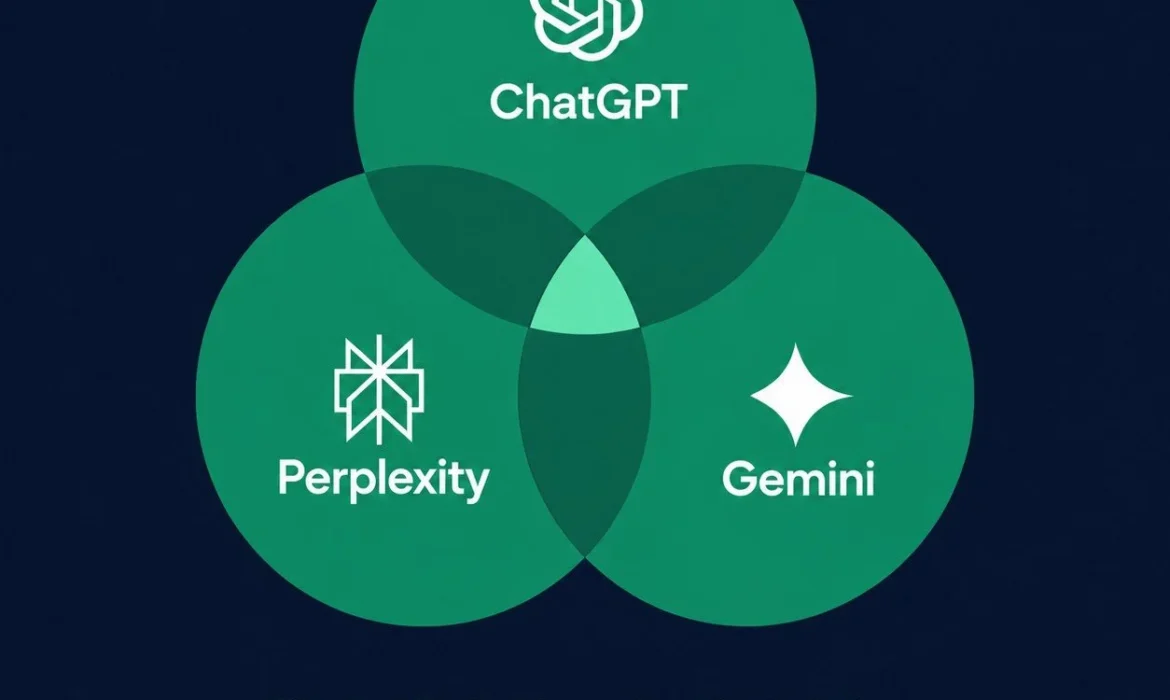
If you’ve ever gotten cited in ChatGPT and checked Perplexity for the same topic only to find nothing, you haven’t done anything wrong. That’s not a fluke. Research analyzing citation behavior across these platforms found that only about 11% of domains cited by ChatGPT also get cited by Perplexity for comparable queries. A separate study tracking the same brand’s content across six platforms over 90 days found citation volume swinging by as much as 615 times between them.
That’s not “AI search” behaving inconsistently. That’s three separate systems, built on different retrieval architectures, that happen to share a chat interface. Treating them as one target is why a lot of AI-visibility effort quietly fails, you’re optimizing for one system’s preferences and expecting all three to respond.
Here’s what each one is actually doing, and what it means for how to get your website cited by ChatGPT, Gemini, and Google AI Overviews.
The numbers that prove these are basically different search engines
A 2026 academic analysis across 11,500 queries found that GPT-4o’s cited sources overlapped with Google’s own top 10 results at a median of 0%. Perplexity’s Sonar Pro model overlapped with Google’s top 10 at 14.3%. Gemini overlapped at 8.5%. If ChatGPT isn’t drawing from anything close to Google’s index, and Perplexity and Gemini only partially do, that alone tells you a single SEO strategy built around ranking well in Google isn’t going to carry equally across all three.
Another dataset, built from 34,000+ AI-generated responses, found ChatGPT cited brand websites in only about 0.6% of relevant answers, while Perplexity cited them in roughly 13%. That’s a 20x difference in how often the two platforms are willing to point at a source at all.
What each platform is actually optimizing for
ChatGPT leans on trust signals inherited from traditional search. Domain authority and an established backlink profile still carry real weight here, closer to classic SEO than anything else on this list. It also cites far fewer sources per answer than Perplexity does, meaning a ChatGPT citation is harder to earn but signals stronger authority when you get one.
Perplexity is built around real-time retrieval, not accumulated authority. It cites roughly 22 sources per answer on average, compared to ChatGPT’s roughly 8, which means there’s simply more room to get included. But that room comes with a different bar: freshness, structured data that’s easy to extract, and a neutral, explain-rather-than-sell tone matter more here than backlink count does. Perplexity’s visible bias toward encyclopedic-style sources isn’t a coincidence.
Gemini is grounded in Google’s own search index, which makes it the one platform where your existing organic ranking directly matters. If a page doesn’t rank well in Google already, Gemini has less reason to surface it either. Unlike Perplexity, it doesn’t consistently show inline citations for every claim, so its citation behavior is quieter and harder to observe directly, but the underlying dependency on Google’s index is the throughline.
What this actually means for how you structure content
Stop writing one “AI-optimized” version of a page and hoping it lands everywhere. Build in signals for all three deliberately:
- Keep building real backlinks and domain authority. This still matters, specifically for ChatGPT citations, more than most current AI-search advice admits. Skipping link building because “AI doesn’t care about backlinks” is only true for one of the three platforms.
- Add schema markup to every page, not just your best ones. Structured data appears to help every one of these systems extract facts more reliably, and it’s one of the few signals that seems to help across all three rather than favoring just one.
- Write in a neutral, explanatory tone, especially on pages meant to earn Perplexity citations. Content that reads like it’s teaching rather than selling performs better here, which is worth knowing before you write another page with a sales pitch baked into the middle of it.
- Keep content genuinely fresh, with visible update dates. Perplexity’s retrieval-first design rewards recency more directly than the other two.
- Don’t neglect classic Google ranking factors. If Gemini citation matters to your audience, ranking well organically in Google is close to a prerequisite, not a separate initiative.
None of these trade off against each other. A page with strong backlinks, clean schema, a neutral tone, current information, and solid organic Google rankings is positioned reasonably well across all three. A page optimized for only one of those signals will keep winning one platform and losing the other two.
Track them separately, because the results genuinely differ per platform
One study tracking real B2B brands across ChatGPT, Perplexity, Gemini, and Claude for 90 days found the citation profile on each platform looked different enough that they could have passed for four different companies. A brand dominant in Perplexity’s citation pool was sometimes nearly invisible on ChatGPT, and vice versa.
That means checking “are we cited by AI” as a single yes/no question misses most of the picture. If you’re serious about this, you need visibility into each platform individually, not a single combined number. I’ve written before about the tools and metrics worth tracking for AI search visibility, and this per-platform variance is exactly why that tracking has to be granular, not aggregated.
The actual takeaway
Stop asking “how do I get cited by AI search.” That question assumes one target. The real question is which of these three platforms your actual audience uses, and building content that satisfies each one’s specific preferences rather than a generic idea of what “AI-friendly content” looks like. Backlinks and domain authority for ChatGPT. Freshness, structure, and neutral tone for Perplexity—solid organic Google rankings for Gemini. Schema markup helps across the board. Do all four, and you stop losing two platforms every time you win one.