
Every SEO agency’s pitch deck has a slide that says something like “professional keyword research requires professional tools.” What that slide doesn’t say is which parts of your keyword research actually need a $130+/month subscription and which parts you’ve been able to do for free the entire time.
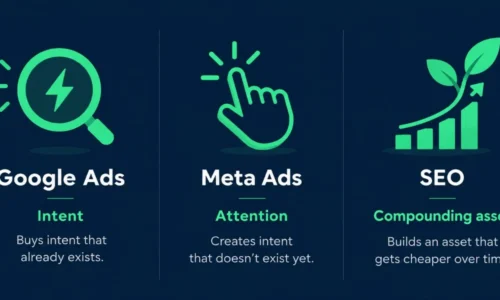
Both things are true at once. Free tools cover more ground than agencies like to admit. Paid tools do a few specific things free tools genuinely cannot. The honest answer depends on what you’re actually trying to do, not on which side of the pitch you’re standing on. And if you’re weighing this against paid ad channels too, the same question applies: what are you actually paying for, and what job does it need to do?
What free tools actually do well
Google Keyword Planner, used properly, gives you real search volume and related keyword ideas straight from Google’s own data. Google Search Console shows you the exact queries already sending you traffic and impressions, which is data no third-party tool can give you because it’s your own account activity. Google Trends shows direction and seasonality. AnswerThePublic’s free tier clusters question-based searches well enough to build a content calendar from. Ubersuggest and a handful of others offer limited free daily searches that are plenty for a solo operator working on one site.
Put together, that stack answers the two questions most small businesses actually have: what do people search for, and roughly how often. For a single site, a beginner, or someone validating a new content idea before committing budget to it, that’s a genuinely complete starting toolkit. Nobody needs to spend $130 a month to find out whether “best running shoes for flat feet” gets searched more than “running shoes for flat feet reviews.”
Where free tools hit a real wall
The gaps aren’t imaginary; they’re just narrower than agencies make them sound.
Search volume without ad spend is a range, not a number. Google’s own documentation confirms this: if you’re not running an active ad campaign, Keyword Planner shows you volume in buckets like “1K-10K” instead of a specific figure. That’s fine for prioritizing broad topics. It’s not fine if you’re deciding between two similar keywords and need to know which one actually gets more searches.
The “competition” score in Keyword Planner measures paid competition, not organic ranking difficulty. This trips up more people than any other single misunderstanding in keyword research. A keyword can show “low competition” in Keyword Planner because few advertisers bid on it, while 40 well-established sites are fighting to rank for it organically. Free tools have no real substitute for an organic keyword difficulty score built from actual ranking data.
Competitor gap analysis basically doesn’t exist for free. Seeing every keyword a competitor ranks for that you don’t is the single most useful thing a paid tool does, and there’s no free equivalent that does it at any real depth. You can guess at a competitor’s keywords by reading their pages manually. You cannot see their full organic footprint without a tool built to crawl and index it.
Backlink data is almost entirely a paid-tool category. Free options exist, but the index sizes are small enough that they miss most of what’s actually happening. If any part of your strategy depends on understanding who links to you or your competitors, this is the point where free tools stop being a real option.
Scale is the quiet dealbreaker. One site, occasional research, no problem. Multiple clients, multiple sites, or ongoing rank tracking across hundreds of keywords, and the free-tool patchwork turns into hours of manual work every week that a paid tool does in minutes.
The part agencies don’t say out loud
Here’s the myth worth busting directly: you rarely need the plan the agency is trying to sell you.
Ahrefs’ entry tier runs around $129 a month. Semrush’s entry tier runs around $140. Those cover keyword research, basic competitor analysis, and rank tracking for a single site or a small handful of them, which is exactly what a solo marketer or a small in-house team needs. The $450 to $500 a month tiers exist for agencies managing dozens of client accounts at once, tracking thousands of keywords, and running enterprise crawl limits. If you’re managing your own site or one client’s, being sold that tier is being sold capacity you’ll never use.
The honest sales pitch would be: “You need a $130 tool, not a $500 one.” That pitch doesn’t happen often, because the bigger number is the bigger commission.
The actual decision
Skip the “which tool” question and answer this one first: what are you actually blocked on right now?
- Blocked on ideas or direction. You don’t know what to write about, or whether a topic gets searched at all. Free tools solve this completely. Google Keyword Planner, Search Console, and Google Trends together are enough. Don’t spend money here.
- Blocked on precision between close options. You’re choosing between two or three similar keywords, and the decision actually matters for a real content investment. This is where free tools’ range-based data starts costing you more in wasted content than a $130 subscription would.
- Blocked on understanding competitors. You want to know what’s actually working for the sites outranking you, not guess at it. There’s no honest free substitute for this. This is the single clearest case for paying.
- Blocked on scale. You’re managing more than one site, tracking keyword rankings over time, or doing this for clients. Paid tools stop being optional here because the time saved pays for the subscription within the first week.
If you only recognize yourself in the first category, free tools are enough. Full stop, and don’t let anyone tell you otherwise. If you recognize yourself in the last three, the entry-level paid tier, not the enterprise one, is almost certainly the right call.
Most people asking “do I need paid tools” already know the answer. They’re either avoiding a $130 line item they’ve genuinely outgrown free tools for, or they’re one sales call away from paying for a $500 plan built for a business ten times their size. Neither mistake is about the tools. Both are about being honest with yourself about which of the four categories above you’re actually standing in.
For more practical SEO and digital marketing insights, visit sawanjha.com.