“Which one should I invest in?” assumes you’re picking one lane and staying in it. Almost nobody who’s actually growing a business runs it that way. They run two, sometimes all three, at different volumes depending on what stage they’re at. The real question isn’t which channel wins. It’s which job each channel is actually good at, and which job your business needs done right now.
Let’s get specific about what each one actually costs and does in 2026, then build a framework you can actually use.
What each channel actually costs right now
Google Ads. Cross-industry average CPC sits somewhere around $4 to $5 in 2026, but that number hides a massive range. Arts and entertainment clicks run under $2. Legal and home improvement clicks run $8 to $10. Most small businesses running Google Ads spend somewhere between $1,500 and $5,000 a month once you’re past the “just testing it” phase, and you’re paying for every single click whether it converts or not. AI Overviews are already changing how much that Google Ads click is worth, which makes understanding the changing search landscape increasingly important.
Meta Ads. Average CPM (cost per 1,000 impressions) landed around $14 in 2026, up roughly 20% year over year. Blended CPC runs somewhere in the $0.70 to $1.70 range depending on placement and objective. Cost per acquisition climbed close to $38, and it’s rising faster than CPC, which tells you conversion rates are holding flat while it gets more expensive just to get in front of people. Reels placements run 20-40% cheaper than Feed if your creative is built for it.
SEO. A serious small business retainer runs $750 to $3,000 a month for local and regional work, more if you’re in a competitive niche. It’s the only one of the three where you’re not paying for traffic directly. You’re paying for the work that eventually produces traffic that keeps showing up whether you pay this month or not.
Notice what’s missing from that comparison: a clean “cheapest wins” answer. There isn’t one, because the three aren’t buying the same thing.
The real difference is what each channel is for
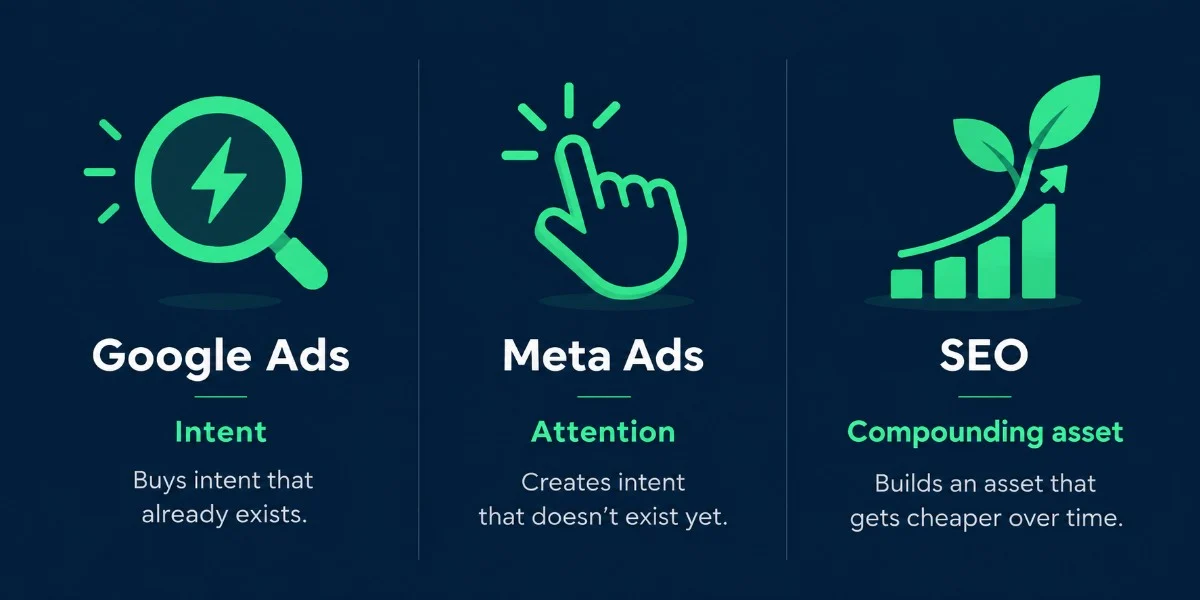
Google Ads buys intent that already exists. Someone typed “emergency plumber near me” or “best CRM for small teams.” They know what they want. You’re paying to be the answer they see first. That’s why Google Ads converts faster than the other two, and why it stays expensive: you’re bidding against everyone else who also knows that searcher is ready to act.
Meta Ads creates intent that doesn’t exist yet. Nobody’s scrolling Instagram looking for your product. You’re interrupting them with something visual enough to make them stop and want it. That’s a fundamentally harder job than answering a search, which is exactly why it needs strong creative to work, and why weak creative just burns budget at a rising CPM with nothing to show for it.
SEO builds an asset that gets cheaper over time instead of more expensive. The tradeoff is time. Realistic timelines for material SEO results run 6 to 12 months, not 6 to 12 days. Nobody serious will promise you page-one rankings in month two. But a page ranking well in month 14 is still pulling traffic in month 30 without a fresh check written every time someone views it. The earlier piece on what AI search is doing to Google Ads also helps explain why businesses need to think beyond simply buying individual clicks.
That’s the actual difference. Not “which is better.” Which job needs doing.
[IMAGE: Simple three-column comparison graphic showing Google Ads (intent), Meta Ads (attention), SEO (compounding asset), each with a small icon]
The framework: how to actually decide
Run through these in order. Most businesses land on more than one.
- You have real demand today, and cash flow depends on this month’s leads. Start with Google Ads. It’s the fastest path from budget to booked customer, and it’s the only channel of the three built to answer intent that already exists.
- You have a visual product, a new brand, or a category people don’t search for by name yet. Meta Ads earns its budget here. Nobody searches “modular standing desk with a walnut top I didn’t know I wanted,” but they’ll stop scrolling for one.
- You have 6+ months of runway, and you’re tired of paying per lead forever. Put real budget into SEO. It’s the only one of the three where stopping spend doesn’t immediately stop results, and the only one where your cost per lead trends down over time instead of up.
- You have a real budget (not $500 total, an actual monthly number) and you want to stop guessing. Run two at once. Google Ads for the leads you need this quarter, SEO for the ones you’ll need next year, and stop treating it as either-or.
The businesses that actually struggle aren’t the ones running two channels. They’re the ones running one channel forever because switching feels like starting over, while their cost per lead quietly climbs every year their competitors invest in the channel they’ve been ignoring.
If you can only afford one channel to start
Start with whichever channel matches your most urgent problem: Google Ads if you need leads this month, Meta Ads if you need to build awareness for something new, SEO if you have the runway and want to stop renting your traffic. Then, once that channel is producing predictably, take a slice of what it’s earning you and start the next one. SEO in particular needs to start before you need it, because the 6- to 12-month runway doesn’t shrink just because you finally have budget for it.
The businesses spending $18,000 to $60,000 a year on a single paid channel, with nothing compounding underneath it, are the ones who’ll be writing the same check five years from now with nothing to show for it except this month’s leads. The businesses that mix paid speed with organic compounding are the ones whose cost per lead actually goes down as the business grows instead of up.
There’s no universal right answer here. There’s a right answer for where your business actually is right now. If you want a second opinion on which mix makes sense for your budget and timeline, that’s the exact conversation we have with clients at Elysian Digital Services before we touch a single campaign or keyword.