Everyone’s asking the wrong question about Google Ads and AI search.
The question going around is “Will AI kill Google Ads?” Wrong question, and the 2026 numbers prove it. Google’s Search & other revenue hit $63.3 billion in Q2 2026, up 17% year over year, a full year into AI Overviews and AI Mode being live everywhere. That’s not a business getting eaten. That’s a business that just had its best quarter in years.
The real question is different: what happens to your ad account when the ad auction itself moves inside an AI answer, and a second ad economy starts forming next to it in ChatGPT? That’s the shift worth understanding. Not because Google Ads is dying. Because how you buy attention is being rebuilt under your feet, on two fronts at once.
Google isn’t losing the ad war. It’s fighting it inside the AI Overview
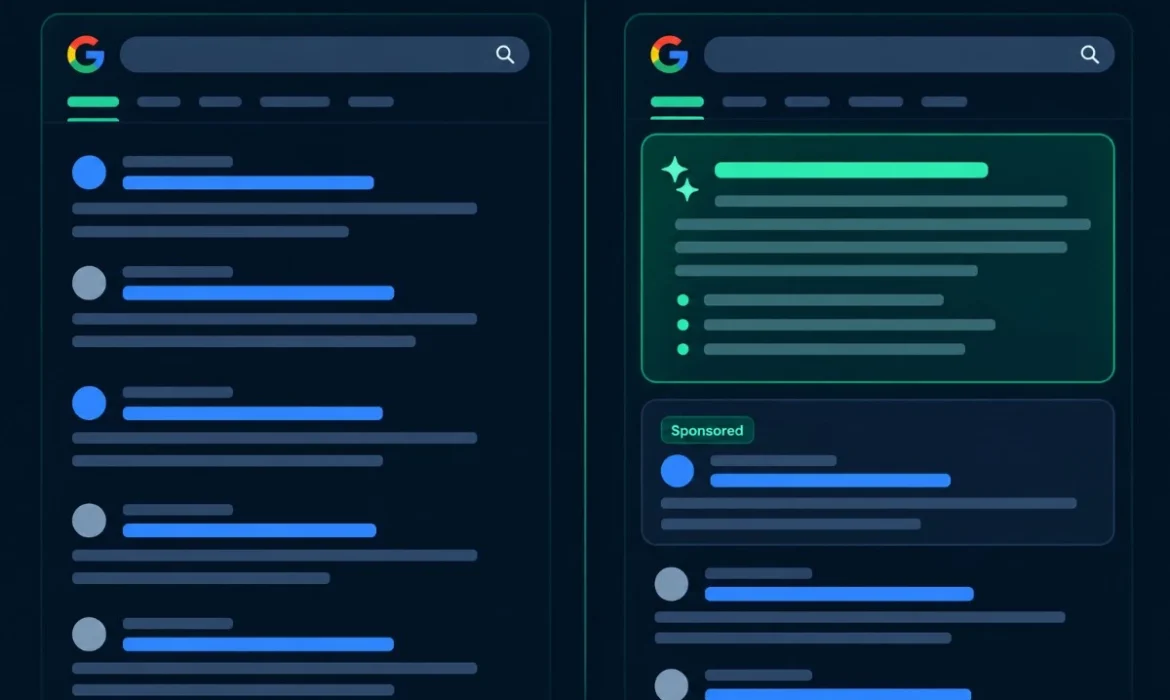
Here’s what actually happened while everyone was predicting Google’s collapse: Google put ads inside the thing that was supposed to kill ads.
Ads now show up at the bottom of roughly 25% of AI Overview results, up from about 3% in January 2025. That’s not a small tweak. That’s Google deciding the AI Overview is inventory, not a threat to inventory.
AI Mode, Google’s fully conversational search experience, passed 1 billion monthly active users in Q2 2026. Ads are technically eligible to show inside AI Mode conversations too, and Google has been clear that more ad inventory will move there through 2026 and beyond.
So the mental model needs updating. It’s not “organic results vs AI answers, with ads caught in the middle.” It’s Google moving its entire ad business inside the AI answer, because that’s where the eyeballs already are.
For advertisers, the practical effect is a loss of control rather than a loss of revenue. You can’t target an AI Overview placement the way you target a keyword. Google decides when and where your ad shows up inside a synthesized answer, based on inferred intent, not the search term you bid on. Bid strategy is shifting from “own this keyword” to “trust Smart Bidding to catch AI-interpreted demand,” and that’s a real change in how much control you’re giving up for the same click.
The click you’re paying for might not exist anymore.
Independent studies on AI Overviews put click-through rates for pages under an AI answer at around 8%, down from roughly 15% on a standard results page. Activation rates for AI Overviews themselves run anywhere from 14% to 36% depending on who’s measuring, but the direction is consistent: a real slice of searches now get answered before anyone reaches a landing page, paid or organic.
This matters more for some queries than others. Informational searches that trigger an AI Overview are the ones losing efficiency for paid search, because the AI answer satisfies the intent before a click happens. High-intent transactional queries-, the “book,” “pricing,” “near me,” “buy” kind- are holding up better because the user still needs to take an action the AI answer can’t complete for them.
If your account is still spending evenly across the funnel the way it did in 2023, you’re bidding for clicks that increasingly don’t happen on the upper-funnel terms. That’s the actual cost of AI search on Google Ads right now, not a collapsing platform, a shrinking set of terms worth paying full price for.
The real disruption is coming from outside Google, not inside it
While Google was busy defending its own SERP, a second ad market opened up somewhere nobody was bidding six months ago. OpenAI launched ads inside ChatGPT on February 9, 2026, starting with Free and Go tier users in the US. By May, it had a self-serve ads manager live. By July 2026, ads were appearing in 51% of US ChatGPT replies. By the end of August, OpenAI’s ad business had reportedly crossed $1 billion in annualized revenue, up from around $100 million just seven months earlier.
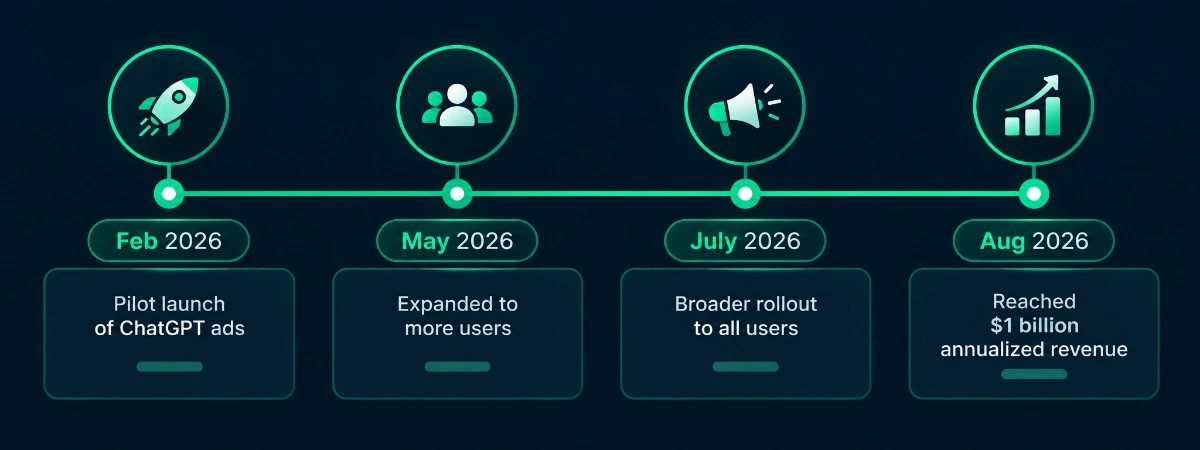
That growth curve matters more than the dollar figure. Google took years to build the ad business it has now. ChatGPT built a billion-dollar run rate in about seven months, on the back of hundreds of millions of weekly active users who were never going to convert to a paid subscription anyway.
The buying behavior inside ChatGPT looks closer to search than to social. Someone typing “I run 20 miles a week and my knees hurt, what shoe should I get” into ChatGPT is expressing the same kind of purchase intent they’d type into Google, just in a messier, more conversational form. That’s exactly the kind of query Google Ads has monetized for two decades. Now there’s a second place to buy it.
So should you actually move budget out of Google Ads?
Not yet, and not much. Google Search still drove somewhere north of $230 billion in ad revenue in 2025 alone. ChatGPT’s ad business, even at a billion-dollar run rate, is a rounding error next to that by comparison. Most advertisers testing AI-assistant ad inventory right now are putting somewhere between 3% and 10% of paid search budget toward it, treating it as a learning line item rather than a real channel switch.
What should actually change in 2026:
- Stop bidding evenly across informational and transactional terms. Push budget toward queries where a click still has to happen for the sale to close.
- Feed every offline conversion, call, and CRM outcome back into Google Ads so Smart Bidding optimizes for what actually makes money, not just for clicks that may not exist anymore.
- Set aside a small, separate test budget for ChatGPT ads if your customers skew toward the demographics already spending time there. Treat it as R&D, not a Google Ads replacement.
- Watch your AI Overview visibility the same way you’d watch a competitor’s ad position. Getting cited inside those answers in the first place is becoming an important part of that visibility. If AI answers are absorbing your category’s informational searches, your organic and AI-citation strategy now directly affects how much you have to spend on ads to get the same volume.
The moat isn’t gone. It’s being rebuilt in a place you don’t fully control
Google Ads isn’t dying. The numbers say the opposite; Google’s ad business grew faster in 2026 than most people expected. What’s actually happening is more specific and more useful to understand: the auction is moving inside the AI answer where Google decides the placement, not you, and a second, faster-growing ad economy is forming next to it in ChatGPT.
If you’re still planning your 2026 and 2027 ad budget as if Google Search results look the way they did in 2022, you’re not protecting your spend. You’re just spending it less efficiently than the advertiser next to you who already adjusted.