Most “complete SEO guides” hand you 50 tips in no particular order and let you figure out the sequence yourself. That’s backwards. On a brand new website, the order you do things in matters almost as much as the things themselves. Get the sequence right and every later step compounds. Get it wrong, and you spend the next year fixing a foundation instead of building on top of it.
Here’s the actual order, from the day your site goes live through the point where SEO starts paying for itself.
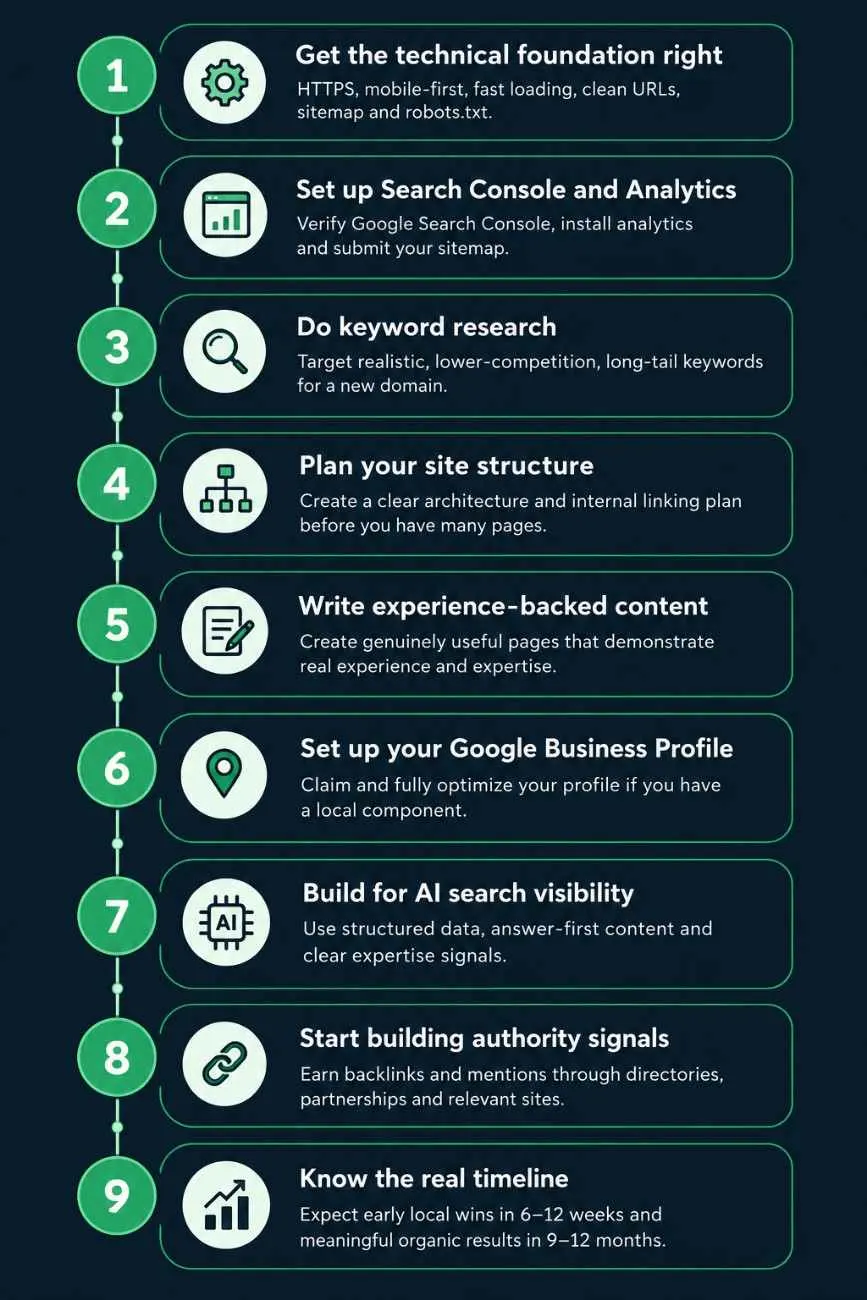
Step 1: Get the technical foundation right before you write a single page
Nothing else on this list matters if Google can’t crawl and load your site properly.
- HTTPS by default. Not optional; it hasn’t been for years.
- Mobile-first, genuinely. Google indexes the mobile version of your site, not the desktop one. If your mobile experience is an afterthought, so is your ranking potential.
- Page speed. Aim for a Largest Contentful Paint under 2.5 seconds. Sites that load fast on a mid-range phone on average mobile data will consistently outperform sites that only look fast on a developer’s fibre connection.
- Clean, readable URLs. /services/local-seo, not /page?id=4471.
- An XML sitemap and a robots.txt file that isn’t accidentally blocking your entire site. This sounds obvious. It’s also the single most common launch mistake: a staging noindex tag that never gets removed after go-live.
Do this before content, not after. Retrofitting technical SEO onto a year-old site with hundreds of indexed pages is a much bigger job than getting it right on day one.
Step 2: Set up Search Console and Analytics before you publish anything
Verify Google Search Console and install analytics before your first real page goes live, not after you notice something’s wrong. Two reasons this matters more on a new site than an established one: you need a clean baseline to measure growth against, and Search Console is how you’ll find indexing problems in week one instead of month four.
Submit your sitemap directly inside Search Console once it’s verified. Don’t wait for Google to discover it on its own.
Step 3: Do keyword research before you write anything, and target realistically for a new domain
A brand new site has zero authority in Google’s eyes. That means chasing the same high-volume, high-competition keywords an established competitor already ranks for is close to pointless in month one. Start with lower-competition, longer-tail terms you can realistically rank for in the next few months, and build toward the competitive terms as your site accumulates authority.
Free tools like Google Keyword Planner and Search Console (once you have some data) are genuinely enough for this stage. If you want the full breakdown of when free tools are enough and when they’re not, I covered that in detail here.
Step 4: Plan your site structure before you have 40 pages to reorganise
Decide your site architecture while you still have a handful of pages, not after you have a hundred. A simple structure: homepage, a small number of core category or service pages, supporting content underneath each one, all connected by deliberate internal links.
Most new sites make the mistake of publishing content in whatever order it gets written, with no plan for how pages link to each other. Orphaned pages, pages with no internal links pointing to them, are some of the weakest performers on any site, and they’re entirely avoidable if you plan the structure up front.
Step 5: Write pages that demonstrate real experience, not just keywords
Google’s quality guidance leans heavily on E-E-A-T: experience, expertise, authoritativeness, trustworthiness. In practice, that means content written by someone who has actually done the thing they’re writing about outperforms generic, arm’s-length content, and this gap has only gotten more visible as AI-generated content has flooded the web.
For a new site with no history, this is your fastest way to stand out. Real author bios, specifics that only come from firsthand experience, actual case examples instead of generic advice. A new site with three genuinely useful, experience-backed pages will outperform a new site with thirty generic ones.
Step 6: Set up your Google Business Profile immediately if you have any local component
If your business serves a specific area, whether that’s a single city or a whole region, claim and fully optimise your Google Business Profile the same week your site launches. It’s one of the few places where a genuinely new business can see visibility in weeks rather than months, since local pack rankings don’t depend on the same accumulated domain authority that organic blue-link rankings do.
Complete every section: categories, services, photos, business description. An incomplete profile competing against fully optimised competitor profiles is giving away an advantage for free.
Step 7: Build for AI search visibility from day one, not as an afterthought
This is the part most “complete SEO guides” still leave out entirely, and it’s no longer optional in 2026. Google’s AI Overviews and AI Mode now sit in front of a huge share of search results, and more buyers start their research in ChatGPT, Gemini, or Perplexity before they ever type into Google.
The good news for a new site: getting cited inside AI answers doesn’t require the same months-long authority-building that traditional rankings do. Well-structured content with clear headings, direct answers up front, and genuine expertise signals can start showing up in AI citations within weeks of publishing, running on a much faster track than the blue-link rankings sitting alongside it.
Practical steps: add structured data (schema markup) to your key pages, write in an answer-first structure rather than burying the direct answer three paragraphs in, and make sure your expertise is genuinely demonstrated, not just claimed. I’ve written in more depth on how to actually get cited by ChatGPT and on what determines whether Google cites your site in AI Overviews, both worth reading before you publish your first batch of pages.
Step 8: Start building authority signals early, not after month six
Backlinks and mentions take time to accumulate and time to have an effect, which means the sites that start earliest have a real head start six months out. You don’t need an aggressive link-building campaign in week one. You do need to start the slow stuff immediately: business directory listings, partner and supplier mentions, any press coverage or community involvement that naturally produces a link, guest content on genuinely relevant sites.
Waiting until your content is “ready” to start this is a common and costly delay. Authority building and content building can run in parallel from day one.
Step 9: Know the real timeline so you don’t quit right before it starts working
This is the step most guides skip, and it’s the one that saves the most businesses from wasting six months of investment for nothing.
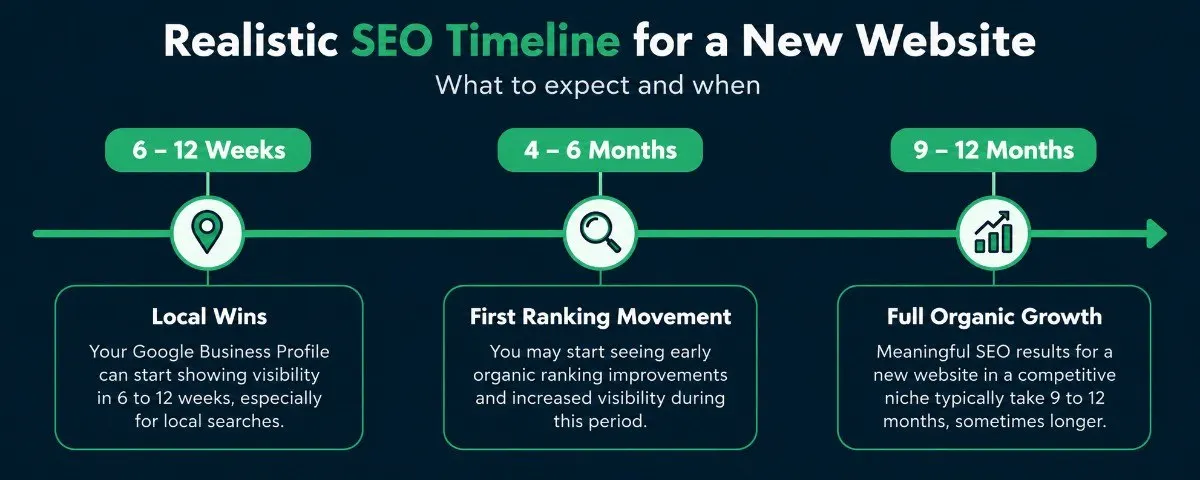
Google’s own developer advocates have said publicly that new sites typically need four months to a year before meaningful SEO results show up. Local businesses with a properly optimised Google Business Profile can see early wins in 6 to 12 weeks, well before the broader organic content strategy matures. Full organic growth for a brand new domain in a genuinely competitive space realistically takes 9 to 12 months, sometimes longer.
The single most common reason SEO “doesn’t work” for small businesses isn’t bad strategy. It’s quitting around month three, exactly when the foundation work finishes and the visible growth is about to begin. If you know that going in, you won’t mistake a normal, slow start for a failing campaign.
The mistake that undoes all of this
Doing these steps out of order. Publishing forty pages of content on a site with broken technical foundations. Building backlinks to pages that don’t demonstrate real expertise. Chasing competitive keywords a two-month-old domain has no realistic shot at, while ignoring the local and long-tail opportunities sitting right in front of it.
SEO for a new website isn’t a list of fifty things to do eventually. It’s a sequence. Technical foundation first, then structure, then content built on real expertise, then authority, running in parallel with a genuine AI search visibility strategy from day one instead of bolted on a year later. Do it in that order, and each step makes the next one work better instead of fighting against a foundation that was never properly laid.
If you’d rather have someone build and run that sequence for you instead of doing all nine steps solo, that’s exactly the kind of ground-up work we do with new website clients at Elysian Digital Services.