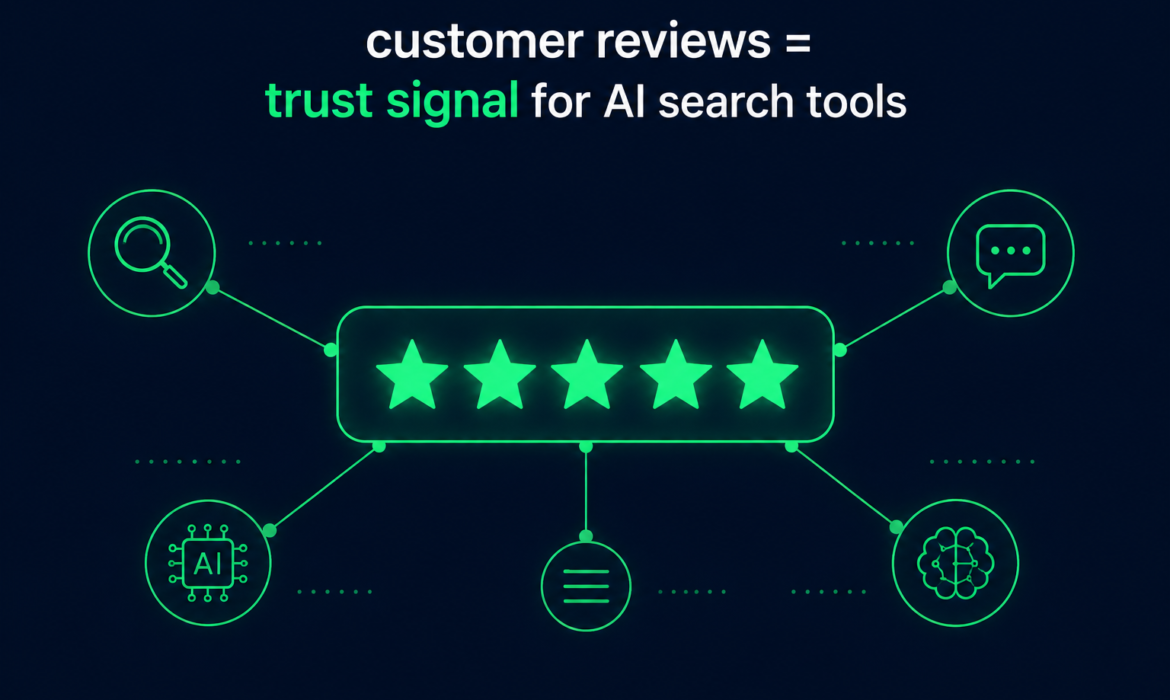
Reviews used to be simple. More stars, more trust, more customers. That part hasn’t changed. What has changed is who’s reading them, and how carefully.
AI search tools like ChatGPT, Gemini, and Google’s AI Overviews now use your reviews as one of the clearest signals available to decide whether your business is trustworthy enough to recommend. And here’s the part most business owners don’t know yet: AI isn’t just counting your stars anymore. It’s starting to check whether those reviews are even real.
Why AI Search Weighs Reviews So Heavily
Think about what an AI tool is actually trying to do when someone asks it, “Which plumber near me is reliable?” It cannot personally verify anything about your business. It has no way to know if you show up on time or do good work. So it looks for the closest thing to real-world proof it can find, and that is customer reviews.
This is fundamentally different from how reviews were used before. In classic search, reviews were mostly treated as numbers, star ratings, and review counts feeding into a ranking formula. AI search reads the actual content. It looks at what customers specifically said, how recently they said it, and whether the language sounds like a genuine experience or something manufactured.
That last part is the piece most guides on this topic miss entirely. Google’s AI is now going a step further than just reading your reviews; it is actively checking whether they were earned honestly. Some businesses are already seeing AI systems follow up with customers after they leave a review, asking whether they were pressured into it or offered something in exchange. That should change how you think about this. It is no longer just “get more reviews.” It is “build a review profile that holds up under scrutiny,” because the scrutiny is now automated.
What Happens If Your Reviews Are Thin, Old, or Inconsistent
If your reviews stopped coming in eight months ago, or you’ve got twelve reviews total while your competitor has two hundred, AI tools notice the gap the same way a cautious customer would. Sparse or stale reviews read as a business that either isn’t active or isn’t well regarded, and AI tools are cautious by design. When the evidence is thin, they simply won’t recommend you, not because you’re a bad business, but because they have nothing solid to point to.
This connects directly to something I covered in how to optimise your local SEO for AI search: AI systems favor businesses that make trust easy to verify. Reviews are one of the fastest ways to do that, and one of the easiest to neglect.
If you’ve already added review markup to your site, this is also where schema comes back into play. Review schema helps search engines and AI tools find and parse your reviews cleanly in the first place, so the content and the code work together, not one without the other.
How to Actually Get More Reviews (Without Breaking the Rules)
Here’s the practical part, and I want to be specific rather than give you the vague “just ask” advice that fills most guides on this.
- Ask right after the moment of value, not weeks later. The best time to ask is immediately after a service is completed, a delivery lands, or a project wraps up, while the experience is still fresh. Waiting a month drops your response rate significantly.
- Use a simple, individualized request, not a mass blast. Send review requests one at a time, tied to that specific customer’s experience, rather than firing off the same message to fifty people simultaneously. Google’s own detection systems flag sudden, unnatural spikes in review volume, and a mass blast is exactly the kind of pattern that gets noticed.
- Make it genuinely easy. A direct link via text or email, or a QR code at checkout or on an invoice, removes the friction that stops people from following through even when they’re happy to leave one.
- Coach for specificity, not for content. You cannot tell a customer what to write, but you can ask a slightly more specific question than “please leave us a review.” Asking “what part of the service stood out to you?” tends to produce detailed, useful reviews naturally, the kind that mention exactly what you did, which is exactly what AI tools find most credible.
- Respond to every review, good and bad. A response shows there’s a real business behind the profile actively engaging with customers, and it is itself a trust signal AI tools read.
- Ask everyone, not just your happiest customers. This isn’t just good practice; it’s now a hard rule. More on that next.
Common Mistakes That Can Now Get You Penalized
This part matters more than it used to, because Google tightened its review policies significantly in an April 2026 update, and several practices that used to be common are now explicitly banned.
Review gating is prohibited. Selectively asking only your happiest customers for a public review while quietly routing unhappy ones elsewhere is against policy, full stop. Ask everyone who had a genuine interaction with your business.
Incentivizing reviews is prohibited. Offering a discount, freebie, or any kind of reward in exchange for a review breaks the rules, whether the review is positive or negative, and whether the incentive is offered to leave a review or to remove one.
Soliciting staff-name mentions is now banned. As of the 2026 update, businesses can no longer coach customers to name a specific employee in their review or run contests tied to staff mentions. A customer organically writing “Jake was great” is completely fine. Engineering that mention is not.
Review quotas are banned. Telling staff to hit a specific number of reviews per week or month is now an explicit policy violation, not just bad practice.
Fake or AI-generated reviews are prohibited. This should be obvious, but it’s worth stating plainly given how tempting AI writing tools make this. Google explicitly prohibits AI-generated review content, and the penalty for getting caught- having your reviews stripped or your profile suspended- is far more costly than the short-term gain.
None of these rules should feel restrictive if you’re doing this the right way. Ask everyone, ask honestly, and let the reviews be real. That’s not just compliance; it’s also what actually builds a review profile AI tools trust.
The Bottom Line
Reviews were always about trust. What’s changed is that AI search tools now read them the way a careful, skeptical human would, checking for recency, specificity, and authenticity, not just counting stars. Build a genuine, consistent review habit into how you run your business, respond to what comes in, and skip anything that even brushes against Google’s current rules. That combination is what actually gets you recommended.
If you found this useful, follow along; I write about exactly this kind of practical AI SEO guidance.