Short answer first, because I know that’s what you’re here for: no, llms.txt will not get you cited by ChatGPT, ranked in Google’s AI Overviews, or found by Perplexity. Google has said this directly. If you’re adding it hoping for an AI-search ranking boost, you’re going to be disappointed.
But that’s not the whole story, and I think most of what’s been written about llms.txt either oversells it or dismisses it without explaining why. So let’s actually get into it: where this file came from, what it was built to do, what’s confirmed versus assumed, and who should genuinely bother building one in 2026.
What llms.txt Actually Is
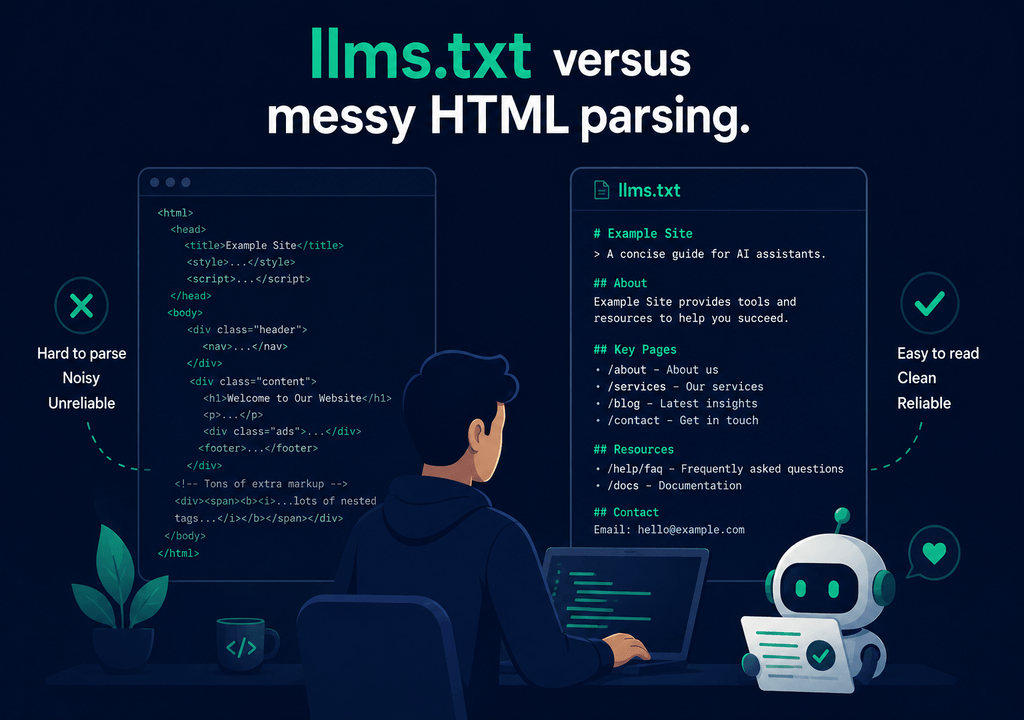
llms.txt is a plain Markdown file you place at the root of your domain, at yourdomain.com/llms.txt. It gives an AI system a curated, human-readable index of your most important pages, usually with a one-line description next to each link.
Here’s roughly what one looks like:
# Company Name
> A one-line summary of what you do
## Docs
– [Getting Started](/docs/quickstart): Setup guide for new users
– [API Reference](/docs/api): Full endpoint documentation
## Policies
– [Returns](/policies/returns): Return and refund terms
That’s it. No schema, no special syntax beyond standard Markdown, no submission process. It’s designed to be dead simple.
Where It Actually Came From
This is where a lot of articles get sloppy, so let’s be precise. llms.txt was proposed on September 3, 2024, by Jeremy Howard, co-founder of Answer.AI and fast.ai. He published the spec on his own site and at llmstxt.org.
The problem he was solving had nothing to do with search rankings or AI visibility. It was a context-window problem. LLMs have a limited amount of text they can process at once, and turning a real website (full of navigation menus, ads, and JavaScript) into clean text an LLM can use is slow and error-prone. Howard’s own project, FastHTML, was the reference example: a piece of documentation-heavy developer tooling where a coding assistant needs fast, clean access to the docs.
In other words, llms.txt was built for inference-time use by coding tools and AI agents that are actively working inside a codebase, not for getting a brand mentioned in an AI-generated answer to a stranger’s search query.
How the SEO World Got Hold of It
Once the SEO and GEO community found llms.txt, it got reinterpreted as something Howard never proposed: a visibility lever, a new robots.txt for AI search. WordPress plugins added one-click generators. Agencies started listing “llms.txt creation” as a service line item. Conference talks called it essential.
None of that came from Howard, and none of it came from the AI platforms either. It came from an industry that wanted a new lever to pull and found a file shaped enough like one to run with.
What’s Actually Been Confirmed, On the Record
Here’s what the major AI and search companies have actually said, not what the SEO blogosphere has assumed on their behalf.
Google: At Google’s Search Central Deep Dive event in July 2025, Gary Illyes stated plainly that Google does not support llms.txt and has no plans to. John Mueller went further and compared it to the old keywords meta tag: a self-declared file where a site owner tells you what their site is about, when Google could just check the actual content directly. He’s also pointed out that when llms.txt has shown up on some Google-owned properties, it was leftover from an internal content system, not evidence that Search actually reads it.
The clearest statement is in Google’s own documentation. Its AI-optimization guide, updated June 15, 2026, states directly that you don’t need to create machine-readable files like llms.txt to appear in Google Search, including AI Overviews and AI Mode. That line sits under a section literally titled “mythbusting.”
OpenAI, Anthropic, Perplexity: None of them document llms.txt as an official citation signal or crawler requirement. OpenAI’s GPTBot documentation talks about robots.txt, not llms.txt. Anthropic publishes its own llms.txt file, which is often cited as a sign of “official support,” but publishing one is not the same as confirming your crawler prioritizes reading it for citation purposes. If you’re chasing what actually gets you cited by ChatGPT, the mechanisms are different from what llms.txt promises.
The contradiction people keep bringing up: If Google says llms.txt does nothing, why did the Chrome team add an llms.txt check to Lighthouse’s agentic-browsing audits around the same time? Mueller addressed this directly: he described llms.txt as a temporary crutch, useful for saving tokens in coding tools parsing developer docs, not something built for search. Both things are true at once. It can be a real, if narrow, convenience for AI coding agents while being completely irrelevant to whether Google or ChatGPT cites your business.
What the Data Says
Beyond the official statements, there are now two independent measurements pointing the same direction.
Ahrefs analyzed 137,000 domains in its Web Analytics data and found that of the sites with a valid llms.txt file, 97% received zero requests for it in May 2026. Not from AI bots, not from anyone.
Separately, an analysis of over 500 million bot traffic events, filtered down specifically to the crawlers that actually drive AI citations (GPTBot, ClaudeBot, PerplexityBot, OAI-SearchBot, and Google-Extended), found that requests to /llms.txt were a statistically negligible share of total traffic. Two different studies, two different methodologies, and they land on the same conclusion: the crawlers that matter for AI search visibility are, for the most part, not reading this file.
Semrush ran its own real-world test on one of its properties, Search Engine Land. Over roughly two and a half months, the llms.txt page received zero visits from Google-Extended, GPTBot, PerplexityBot, or ClaudeBot. Regular crawlers like Googlebot and Bingbot touched it a handful of times, with no special treatment.
If you’re waiting for a fourth data point to break the tie, I wouldn’t hold your breath.
So Where Does It Actually Help?
This is the part most of the “it’s dead” articles skip past too quickly, and it’s worth being fair about.
llms.txt does have a real, working use case: AI coding tools and agentic browsers. Cursor, Windsurf, GitHub Copilot, Claude Code, Cline, and similar tools do look for /llms.txt and /llms-full.txt when they’re pointed at a documentation site, and a well-structured file genuinely helps them generate accurate code against your API instead of hallucinating an endpoint that doesn’t exist. Mintlify’s decision to auto-generate llms.txt across thousands of hosted docs sites in late 2024 is exactly why companies like Cloudflare, Stripe, and Anthropic ship one today. They’re not doing it for SEO. They’re doing it because developers using AI coding assistants are a real, paying audience for their product, and a clean context file removes friction for that specific group.
So the honest split is this: llms.txt does essentially nothing for classic search rankings, AI Overviews, AI Mode, or getting cited by ChatGPT and Perplexity in a general answer. It can genuinely help if your product has technical documentation that developers feed into coding assistants.
Should Your Website Have One in 2026? A Straight Answer by Business Type

You have a SaaS product, API, or developer-facing documentation: Yes, worth doing. Your actual users are the kind of people pointing Cursor or Claude Code at your docs. This is cheap to build and has a plausible, specific payoff.
You run an agency, consultancy, or content-heavy authority site: Optional, low priority. There’s no harm in having one, but don’t expect it to move your AI visibility. Your time is much better spent on the things that do: clean technical SEO, structured data, genuinely original content, and tracking whether AI platforms are actually citing you (which you can check directly rather than guessing).
You run a local business, ecommerce store, or service business: Skip it. There is no realistic scenario where a coding agent is parsing your llms.txt file to route a customer to your dental clinic or your online store. Put that hour into your Google Business Profile, your review strategy, or your core on-page SEO instead.
You’re not sure and just want to experiment: Fine, go ahead. It costs almost nothing to build and there’s minimal downside, beyond the fact that a public, curated map of your best content is also a slightly easier scrape for a competitor. Just go in knowing what the data actually shows, not what a LinkedIn post promised.
If You’re Building One Anyway: How to Do It Properly
If you’ve read all of the above and still want one, here’s how to do it right.
- Decide the scope. Are you covering your whole site or just a documentation subdirectory? Most of the value case above points to documentation, so if you have both a marketing site and separate docs, it’s usually worth building llms.txt specifically for the docs.
- Pick your most important pages. Don’t dump your entire sitemap in here. The whole point is curation. Think API references, quickstart guides, pricing, key policies, and your most load-bearing content, not your archive of old blog posts.
- Structure it in Markdown. The format is intentionally minimal:
- One # H1 with your site or product name
- An optional > blockquote with a one-line summary
- ## H2 sections to group links by category (Docs, Products, Policies, etc.)
- Each link with a short description of what it leads to
- Keep it lean. This isn’t meant to be a full sitemap. Aim for a file that’s genuinely useful to scan in a few seconds, not a wall of links.
- Host it at the root. It needs to live at yourdomain.com/llms.txt (or docs.yourdomain.com/llms.txt if it’s docs-specific) to be found at all.
- Don’t block it in robots.txt. This sounds obvious, but it’s one of the most common mistakes. If your robots.txt disallows the path, the file is invisible no matter how well you built it.
- Consider noindexing the file itself. Mueller has suggested this so the file doesn’t get picked up and indexed as a regular page in Google Search, since it’s not meant for human search results.
- Update it like you would a sitemap. Treat it as a living document. Remove dead links, add new key pages, and don’t let it go stale.
- Validate it. Use a free llms.txt validator or generator to confirm your Markdown is well-formed before you consider it done.
The Bottom Line
llms.txt is not the new robots.txt, and it’s not a GEO ranking lever, no matter how many agencies are selling it as one. It was built to solve a narrow, real problem: giving AI coding tools clean, fast access to technical documentation. Google has said clearly it doesn’t use it for Search or AI Overviews, OpenAI and Anthropic haven’t confirmed it as a citation signal, and two independent traffic studies show the crawlers that actually matter for AI visibility mostly aren’t requesting the file at all.
If you run a documentation-heavy product, build one; it’s cheap, and it has a real audience. If you’re running a local business, an ecommerce store, or a content site chasing AI Overviews citations, spend your time elsewhere. Start by checking whether Google is actually citing you in AI Overviews, since that tells you more than any file ever will. The fundamentals still work the way they always have: crawlable pages, structured data, genuinely useful content, and a real answer to what people are actually asking.