Last year, one of my clients, a family and cosmetic dentistry practice in Newark, Delaware, came to me with a problem that many local businesses are facing right now.
They were getting impressions on Google. Their rankings were decent. But something was off. The calls did not match the visibility. The traffic felt inconsistent. And when I asked them to search for “dentist in Newark, DE” and show me what came up, their website was there, but they had no idea whether Google’s AI was actually referencing them or skipping them entirely.
That question, ” Is Google citing my website in AI Overviews?, is something I am now getting from almost every client I work with. And honestly, most businesses have no idea how to answer it.
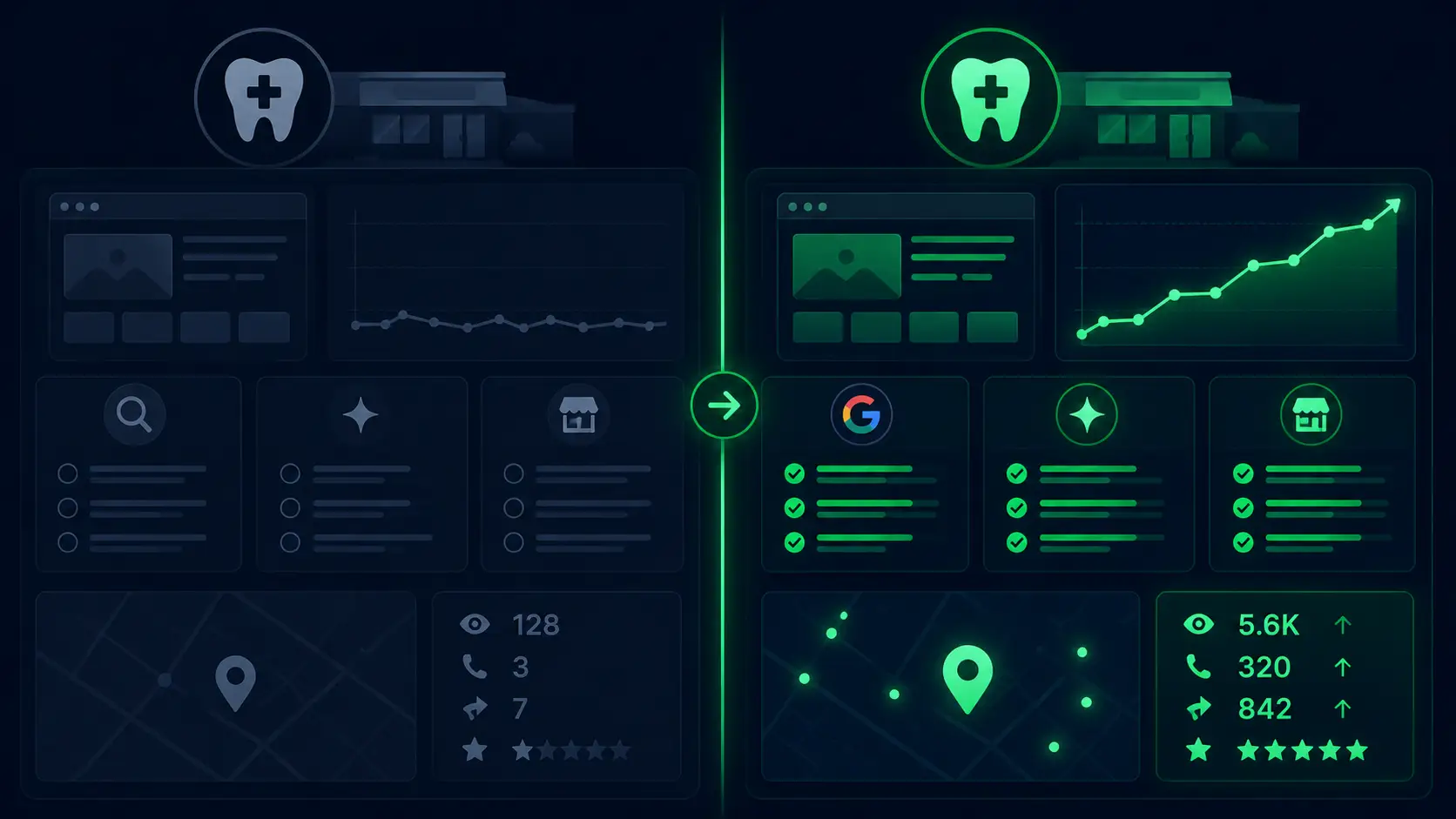
So we got to work. We audited their presence, rebuilt their content strategy, optimised their Google Business Profile, and focused heavily on the signals that AI systems use to decide who to recommend. Within a few months, Main Street Dental went from being invisible in AI search to being recommended by ChatGPT as one of the top 5 dental providers in Newark, alongside practices with significantly more reviews and longer histories.
Their Google Search Console clicks jumped from 415 to over 4,300 in three months. Calls from their Google Business Profile increased by 88.6% year over year.
That result started with one thing: understanding where they stood in AI search and why. That is exactly what this article is going to help you do.
First, Let’s Understand How Google AI Overviews Actually Work
Before you can figure out whether you are being cited, you need to understand what is happening under the hood. Bear with me, this section is going to make everything else in this article make much more sense.
Google AI Overviews are powered by a combination of Google’s own large language models and a technique called Retrieval Augmented Generation, or RAG. These are terms you will hear a lot in the SEO world right now, so let me explain both in plain English.
What is a Large Language Model (LLM)?
A large language model is an AI system trained on enormous amounts of text, books, websites, articles, forums, and documentation, essentially a significant portion of the publicly available internet. Through that training, the model learns patterns in language, how concepts relate to each other, and how to generate human-sounding responses to questions.
ChatGPT is powered by an LLM. Google’s Gemini is an LLM. The AI that generates Google’s AI Overviews is built on Google’s own LLM technology.
But here is the important thing to understand: LLMs do not just rely on what they learned during training. They would quickly become outdated if they did. This is where RAG comes in.
What is Retrieval Augmented Generation (RAG)?
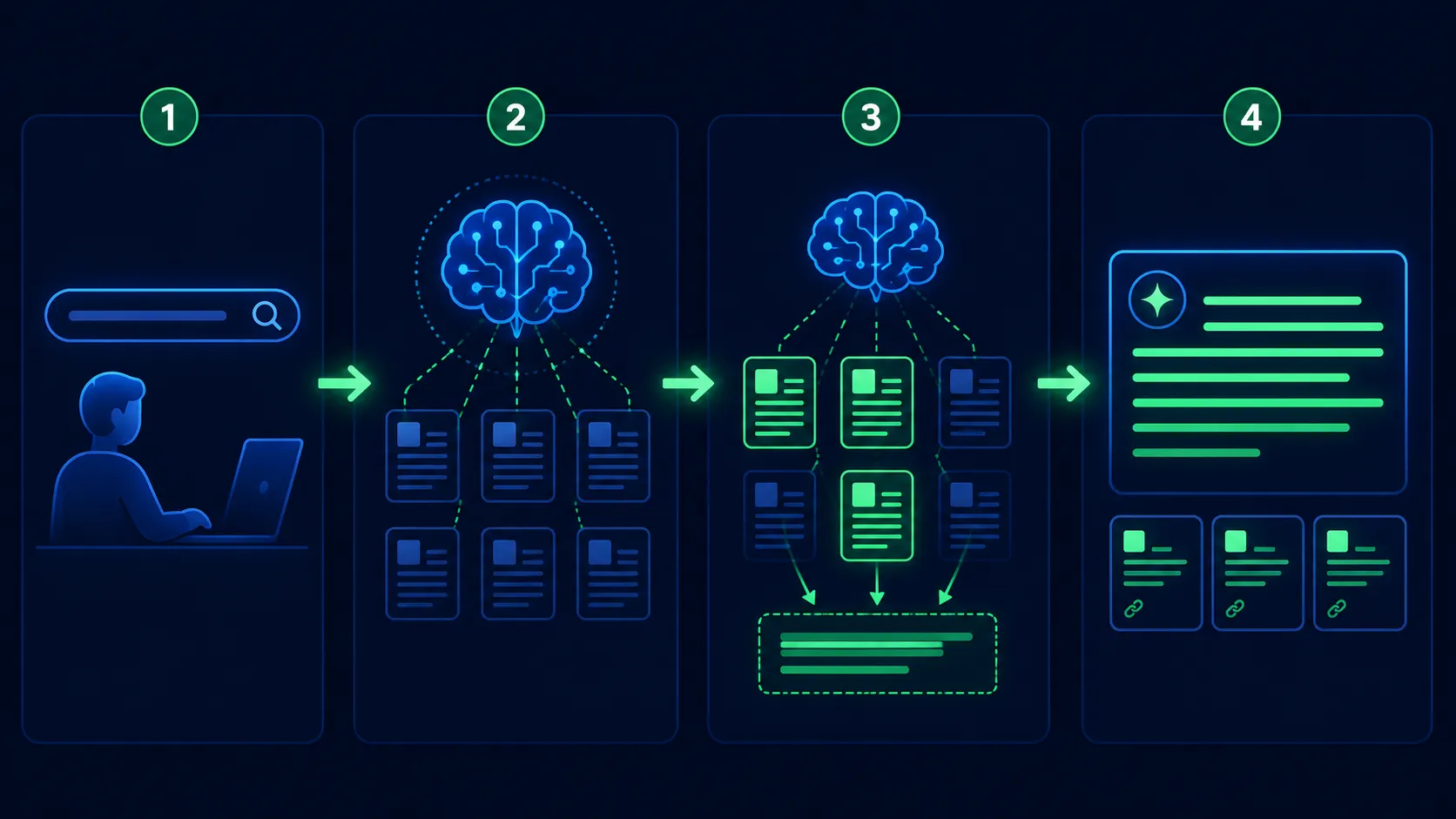
RAG is the process by which an AI system retrieves fresh, relevant information from the web, or from a specific set of documents, at the moment someone asks a question, and uses that retrieved information to generate its answer.
Think of it this way. The LLM is like an extremely well-read person who has studied millions of books and websites. RAG is the process of that person quickly searching the internet right before answering your question, so their answer is grounded in current, specific, and verifiable information rather than just what they remember from their studies.
When Google generates an AI Overview for a search query, it is using RAG to pull relevant content from across the web, including your website, if it considers your content trustworthy and relevant, and synthesising that content into the summary the user sees.
Where does your website fit into this?
This is the part that directly affects your business. When someone searches “dentist in Newark DE” or “best family dentist near me,” Google’s AI system goes through roughly this process:
It identifies the query type and intent. It retrieves content from websites it considers authoritative and relevant for that query. It synthesises that content into a summary. It cites the sources it used.
Your website either makes it into that retrieval step, or it does not. And whether it does depends on the signals your website is or is not sending. More on that shortly.
The key thing RAG tells us as SEOs and business owners is this: the AI is not making things up. It is retrieving real content from real sources. So if your website has the right content, structured the right way, with the right trust signals, you have a genuine shot at being cited.
How Often Are AI Overviews Actually Appearing?
Before we get into how to check your own citations, it is worth understanding the scale of what we are dealing with.
AI Overviews now appear on nearly half of all Google searches, up from 31% in early 2025 to 48% by February 2026, according to BrightEdge data. At peak periods, they have crossed 50% of all tracked queries.
That is not a niche feature anymore. That is the mainstream Google experience for most users.
And here is what makes the citation question so important: when an AI Overview appears, organic click-through rates drop by up to 61%. But websites that are actually cited inside the AI Overview earn 35% more organic clicks than those that are not cited at all.
So the difference between being cited and not being cited is not just a vanity metric. It is the difference between being in the conversation and being invisible, even if you are ranking.
How to Check If Your Website Is Being Cited in AI Overviews
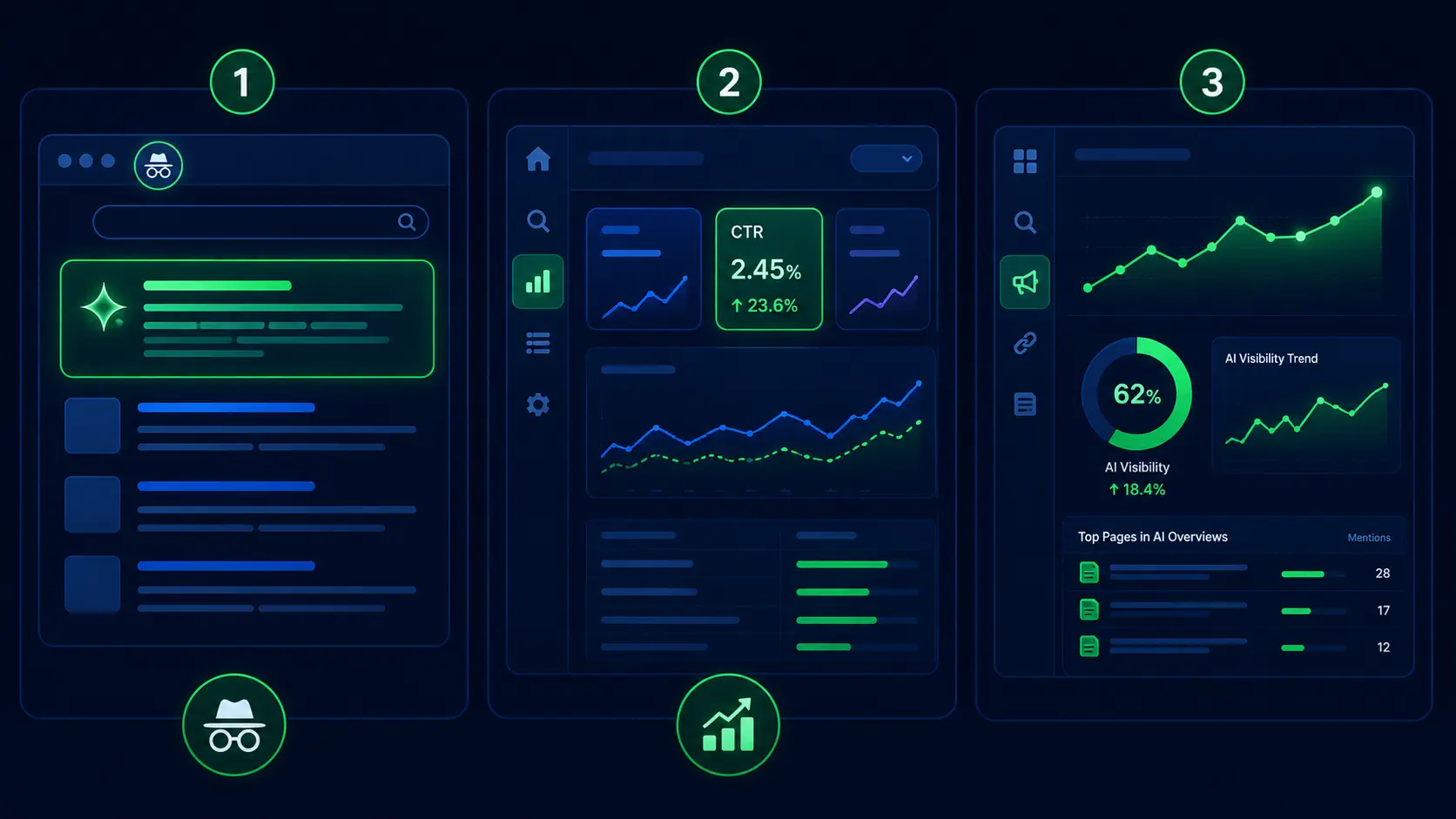
There are three ways to do this, ranging from free and manual to paid and scalable.
Method 1, Manual Search in Incognito Mode
This is the most straightforward starting point and costs nothing.
Open a private or incognito browser window. This is important because your personal search history and location data can influence what Google shows you normally. Then search for your most important target keywords, the ones your customers would actually use to find you.
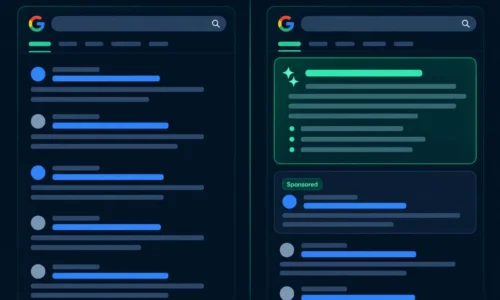
Look for the AI Overview box that appears at the top of the results. If one appears, click “Show more” to expand it and look for the source citations, usually shown as small cards or links at the side or bottom of the summary.
If your website appears in those citations, you are being cited. If it does not, you are not, at least not for that query.
The limitation of this method is scale. You can only check one keyword at a time, and AI Overview appearances can vary by location, device, and even time of day. But it gives you a quick gut-check answer for your most important keywords.
For Main Street Dental, this was actually how we first confirmed they were starting to appear, searching “dentist Newark DE” and “family dentist Newark Delaware” in incognito and seeing their content referenced in the AI summary.
Method 2, Google Search Console
As of June 2025, Google confirmed that AI Overview and AI Mode data are included in the Google Search Console Performance report under the Web search type.
This means you can use Search Console to get a clearer picture of your AI-influenced traffic, though with some important caveats.
Go into your Search Console Performance report. Filter by Search Type: Web. Look for queries where you have high impressions but unusually low click-through rates. This pattern, strong impressions, low CTR, is often a signal that an AI Overview is appearing for that query and absorbing the clicks before users reach your link.
The limitation here is that GSC aggregates AI Overview data with standard organic data in the default view, making precise isolation difficult. But the impression and CTR patterns are telling enough to give you a clear directional read.
Looking at Main Street Dental’s Search Console data, we could see impressions growing from 23,200 to nearly 2 million over three months, a sign that their content was being surfaced more broadly in AI-influenced results, not just traditional organic rankings.
Method 3, Dedicated AI Visibility Tools
For more systematic tracking across a larger set of keywords, there are now dedicated tools built specifically for monitoring AI Overview citations.
Otterly.AI and the Semrush AI Visibility Toolkit are the two I recommend most to clients right now. Both allow you to track which of your target keywords trigger AI Overviews, whether your domain is being cited as a source, and how that visibility changes over time.
These are paid tools but genuinely worth the investment if AI search visibility is a priority for your business, which it should be in 2026. Building AI citation tracking into your monthly reporting cadence is no longer optional for serious SEO.
There is also a free AI Overview Checker tool by GrowthNatives that lets you input your domain and a keyword to check whether you appear as a citation, a good starting point for businesses not ready to invest in a full toolkit yet.
What It Means If You Are Not Being Cited
If you check your key queries and find your website is not appearing in AI Overviews, do not panic. Most websites are not. Only around 274,000 domains have appeared in AI Overviews out of 18.4 million indexed sites. The opportunity is real, but the bar is real too.
Not being cited tells you one or more of these things:
Your content is not structured in a way that is easy for AI to retrieve and summarise. Your website does not have enough trust signals, backlinks, reviews, or mentions on authoritative sites for AI to confidently cite you. Your content may be too thin, too generic, or not directly answer the questions your customers are asking. Your domain authority may not yet be strong enough for the queries you are targeting.
None of these is a permanent problem. They are all fixable, and fixing them is exactly what the next article in this series is going to cover in detail.
The Signals That Determine Whether You Get Cited
While the full guide to getting cited is coming in the next article, here is the short version of what Google’s AI is actually looking for when deciding which sources to include in an AI Overview.
Content that directly answers the query. AI Overview sources tend to be pages that answer the user’s question clearly and concisely, ideally within the first few paragraphs. If a user asks “how much does a dental crown cost in Newark,” a page that answers that question directly, with specific, useful information, is far more likely to be cited than a page that buries the answer or avoids it entirely.
Domain and page authority. Research shows that 76% of AI Overview citations come from pages already ranking in the top 10 organic results. But, and this is the interesting part, 46.5% of cited URLs rank outside the top 50. This tells us that authority and content quality can override pure ranking position. It is not purely a top-10 club.
Freshness. Content under three months old is three times more likely to be cited in AI Overviews than older content. Keeping your key pages updated is not just good SEO practice; it is now directly linked to AI citation likelihood.
E-E-A-T signals. Experience, Expertise, Authoritativeness, and Trustworthiness. Google’s AI looks for the same signals its ranking algorithm does: author credentials, first-hand experience, citations from other trusted sources, and consistent positive reputation signals like reviews and mentions.
Structured data. Schema markup helps AI understand exactly what your content is about, who it is from, and what questions it answers. Pages with clean, accurate, structured data have a meaningfully higher chance of being pulled into AI summaries.
What to Do Right Now, Before the Full Guide
If you have read this far and realised your website is not being cited, here are three things you can do today while you wait for the full citation guide.
Run the manual check first. Open incognito, search your ten most important keywords, and document which ones trigger AI Overviews and whether you appear. This gives you a baseline you can measure against going forward.
Check your Search Console CTR patterns. Look for queries where impressions are growing, but CTR is declining. These are the queries where AI is having the biggest impact on your traffic, and they are your priority targets for citation optimisation.
Audit your top pages for directness. Pick your five most important service or product pages and ask honestly, does this page answer the questions my customers are searching for in the first two paragraphs? If not, that is your first rewrite target.
If you want to go deeper right now and get a proper AI citation audit done for your website, not just a checklist but an actual strategic review of where you stand and what needs to change, book a consultation call here, and we can work through it together.
The Bigger Picture
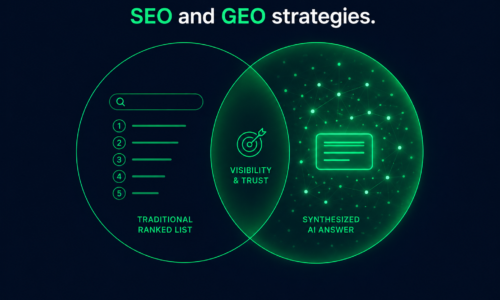
The shift happening in search right now is not a temporary trend. AI Overviews are becoming the default experience for most Google users. The businesses that understand how this system works and actively position themselves to be cited within it, are going to have a significant advantage over the ones that still optimise purely for traditional blue-link rankings.
Main Street Dental is a real example of what happens when a local business takes this seriously early. They were not a giant practice with hundreds of reviews and a massive domain authority. They were a well-run local business that got the right signals in place at the right time, and the results showed up quickly and measurably.
The next article in this series is going to be the full playbook, exactly how to get your website cited by Google AI Overviews, ChatGPT, Gemini, and Perplexity. Step by step, with real examples.
To get that guide the moment it goes live, before it gets shared anywhere else, subscribe to my email list here. It is the fastest way to stay ahead of what is changing in AI search right now.
FAQs
Does ranking on page one guarantee I will be cited in AI Overviews?
Not at all, and this surprises a lot of people. While 76% of AI Overview citations come from top 10 ranking pages, nearly half of the cited URLs rank outside the top 50. Strong, directly relevant content with good trust signals can earn a citation even without a top ranking. It is content quality and authority together, not just position.
How often do AI Overview citations change?
Fairly frequently. AI Overviews are dynamic; Google updates the sources it cites based on freshness, relevance, and ongoing trust signals. A website that is cited today may not be cited next month if a better source publishes newer content. This is why ongoing content updates matter, not just a one-time optimisation.
Can a small business with low domain authority get cited in AI Overviews?
Yes, and Main Street Dental is proof of that. Domain authority matters, but it is not the only signal. Highly specific, well-structured content that directly answers a query, combined with strong local trust signals like reviews and GBP optimisation, can get a small business cited even when competing against larger sites.
What is the difference between being cited in Google AI Overviews versus appearing in ChatGPT?
They are different systems with different data sources. Google AI Overviews pull from indexed web content in real time using RAG. ChatGPT uses a combination of its training data and web browsing when enabled. Appearing in both requires overlapping but slightly different strategies, a strong indexed web presence for Google, and broader third-party mentions and directory listings for ChatGPT. The next article will cover both in detail.
Should I be worried if my competitors are being cited and I am not?
Worried, no. Motivated, yes. A competitor being cited means the opportunity exists in your niche. It also means you can study exactly what they are doing right, their content structure, their trust signals, and their schema markup, and use that as a blueprint for your own citation strategy.